Let's Make Reliability Sexy

Reliability is the most boring word in business.
Most people don't value a reliable person until they hire a flake.
Then suddenly, they look at the person who consistently shows up, delivers, and makes it look easy with hearts in their eyes.
Listen, we reliable people know just how valuable we are. But we can't put it on our resumes.
It's as thrilling as a dial tone and as expected as the sunrise... right up until the person you need the most totally ghosts you.
What Does Reliable Look Like?
Most reliable people fly under the radar. They deliver. They're solid. They don't make a fuss. They see something that needs to be done and just take care of it. Because it's the right thing to do.
They're not usually the ones touting their own accomplishments or demanding attention. Instead, they're the spokes of the wheel: the one thing holding it all together but rarely getting the gold-star treatment.
As an official representative of the Reliable People Guild (trademark pending), I want to say that we are generally fine with this. But when you start taking a reliable person for granted, or worse, relegating them to the sidelines, you're in for a world of hurt.
What Makes Reliable People Leave?
Just like elephants, reliable people remember. We don't necessarily keep score, but we're always watching. When we see you become mesmerized by the shiny new toy clamoring for your attention, we're reminded we need to draw the spotlight to us a bit more. It's not in our nature, but we understand how the game is played.
Maybe that shiny object is cheaper. Maybe they have an MBA after their name. Maybe they worked at some company you think is the bee's knees. Maybe they present themselves really well. Maybe someone in your inner circle referred them to you.
Whatever the catalyst, Shiny Object Syndrome is a real thing. Whether you mean to or not, you start giving the choice morsels to Miss or Mister Ooh Shiny. The fun projects go to them because you "want to see what they can do." The bigger budget projects get handed over because "we have so much to accomplish." As a contractor, this one especially hits home for me because lack of work equals lack of revenue I depend on to feed my children (a dog and two cats).
When the shiny object pans out in your favor, and you can get reliability out of them, it's pure gold. That's why it's so rare. But when that lack of substance rears its ugly head, your old standby reliable person may be mentally or physically out the door.
The Cost of Losing the Reliable
When your reliable person walks, the replacement math is ugly.
SHRM puts the cost of replacing someone at 50 - 200% of their annual salary.
For easy numbers, let's say you pay your reliable person $100k a year. To replace them, you're looking at $150k to $300k, both in hard costs (higher salaries, overtime, recruiting fees) and soft costs (loss of institutional knowledge). Reliable people don't just fill a role; they elevate it. And when they leave, you're much more likely to have to hire multiple people just to maintain the quality and output of your reliable person.
When you look at this "replacing the irreplaceable" math globally, it's staggering. Gallup puts the national tab for voluntary turnover at roughly 1 trillion dollars a year. A trillion dollars, torched because people treated dependable like it was disposable.
It's similar when hiring contractors. Reliable ones typically become woven into the fabric of a business. We learn your shorthand; we become your brain ("Remember that email about chickens you wrote two years ago?"); we embody your voice and brand; we see looming issues and opportunities because we've run into them with you before. A new contractor can't offer that. They also don't offer the same loyalty and urgency as an embedded contractor. Why would they pivot to address your urgent copy update when you've just met? Someone who treats your business like it's their own because they care about you is much more likely to make it work. And that's valuable when you're in a crazy launch, or something has slipped through the cracks. I've seen it countless times.
So when a company trades a steady pro for a cheaper warm body, they think they're saving when they're actually financing. And the payments come due in blown deadlines, redone work, and the special hell of auditioning strangers while the clock runs.
In Good Fast Cheap, Reliable Lives in the Overlap
You know the classic Good, Fast, Cheap Venn diagram? You can only pick two.
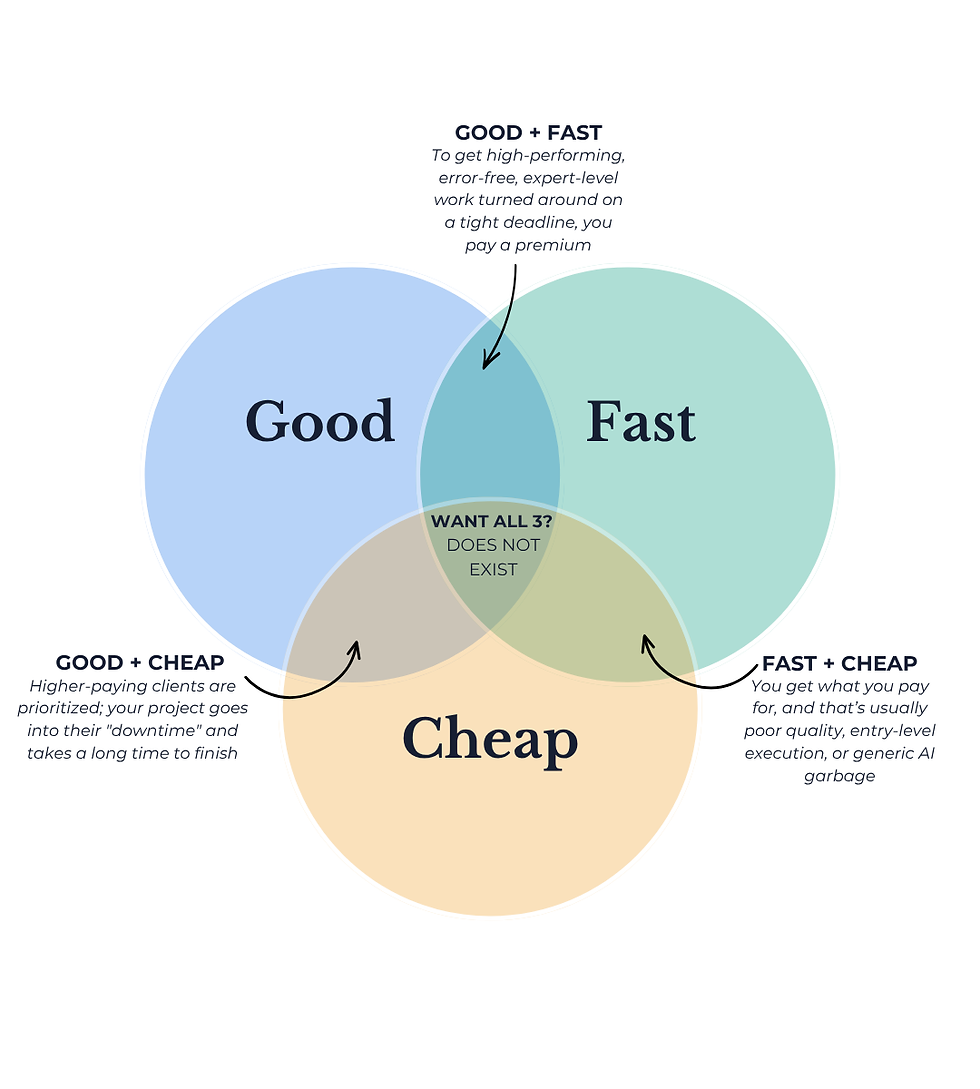
I've found Reliability lives in the overlap of Good and Fast.

Good and fast are the people who know what they're doing. They move fast because they've done it a hundred times, and they get it right because they've done it a hundred times. Competence and dependability are the same muscle.
Now, let's talk directly to the reliable people...
The Downside of Being Reliable Is Getting Taken for Granted
To quote the great Nene Leakes: "I said what I said."
Being excellent and dependable doesn't protect you. Give it enough time, and it can actually cost you.
Most people rise to meet expectations. We reliable overachievers raise our own bar, and soon our best becomes the floor of expectation. We do this so consistently that it is invisible. We never once gave anyone a reason to sweat.
But the problem with invisible is that it's often first on the chopping block. "Let's find someone cheaper" rolls off the tongue much more easily when times are tight, or the volume of work is overwhelming.
As a contractor, I've had it said directly to my face, and I've also experienced the slow withdrawal of work. In some cases, cheaper people I've brought in to help on massive projects have actually replaced me once we drop back to normal levels (that one stings). It's not their fault; we all need work. But I know for an absolute fact that one day, that reliability guillotine will fall. And as things start to come apart at the seams, clients suddenly remember the reliable person they left behind.
Here's what the budget-slashers don't consider: Reliable people have options. We're already fielding the referrals, so we go, taking our steadiness somewhere it's respected. Is the bridge burned? Not always. Sometimes it's just singed. Will we come back? Maybe. But we're less likely to go all-in for you again, because we've seen how valuable you really think we are (aka: not that much).
Reliability Is a Referral Engine
The real reward for being dependable is a full pipeline. Steady work, from people who have already bought into you, with almost none of the chasing.
Reliability is what gets you referred. When a client needs someone they can hand the keys to, they're much more likely to ask someone they trust for a referral. Who wants to scour Fiverr, Upwork, or Indeed for a seasoned launch manager or graphic artist when they can use the same person their successful colleague does?
It's just human nature. And Nielsen's got the receipts. Around 88% of people trust a recommendation from someone they know over any ad ever made, and that number barely moves year to year.
For me, around 95% of my business comes from word of mouth. I don't usually hunt for work. It finds me, because everyone I've shown up for is happy to send the next client my way.
I remember one time I had what I thought was a meet-and-greet with a potential client. By the end of our first half-hour Zoom, he was assigning me work. I said, "Don't you want to know my fee?" Nope, he said. The person who referred me to him had done all that legwork, and he had mentally signed on the dotted line before we even met.
So that's what I mean: Reliability compounds. It's the most slept-on growth strategy in business. And the only cost is doing what you say you will, every time.
How To Make Your Reliability Impossible To Ignore
When budgets tighten, nobody cuts the person they like. They cut the person they think they can live without. That’s the brutal part of a downturn, and it’s why being excellent but under the radar is a liability. If the people above you can’t see your value, they can’t protect it. Here’s how to make it visible before you need them to:
Talk in outcomes, not activity
Nobody upstairs is counting your tasks. They’re counting what those tasks did for the business. So stop reporting the work and start reporting the result.
“I wrote 40 emails” is invisible. “I wrote the entire flight plan, which delivered $23k in sales" is undeniable. Verifiable data is crucial, so attach a number whenever you can: dollars earned, hours returned, headaches alleviated. This requires you to get curious about how your work performs and do some homework. Pay attention to any numbers on work you touch: open rates, click-through rates, conversion rates, opt-in counts, tickets reduced, hours saved. If you have a job, you have a numbers-based reason behind it. So find yours.
Money is a motivating factor for most businesses, so being able to speak confidently (and accurately) about how your efforts contribute to that helps demonstrate your value unemotionally.
Make your value visible without bragging
If your boss only hears from you when something breaks, or a giant project hits your desk, you’re invisible the other 90% of the time. Fix that with one low-effort habit: the Friday wrap-up.
Every Friday afternoon, send your manager a short, punchy email with three lines:
Delivered this week: the wins and milestones, not the busywork
Priorities next week: what you’re driving, so you read as proactive
Blockers: anything that needs their sign-off
Do your best to get face time, too. In other words, an in-person or Zoom meeting where you actually see each other in real time. You don’t have to run the meeting. But ask one insightful question or drop one useful number within the first fifteen minutes. Research shows we have the most attention then, before we start drifting off.
Use "we" language
This one is especially important for contractors. I've seen far too many contractors, freelancers, and consultants use "you" language, which paints you as an outsider. For example, "Here's what you should do." Instead, use "we" language: "Here's what we should do." It's a subtle difference, but it positions you as part of the team (even if you aren't doing any of the actual work). Most humans are hardwired to protect their own, so by positioning yourself as part of the team while delivering that input, subconsciously you're less likely to hit the chopping block.
Make your client or manager look and feel good
This might sound manipulative, but I promise you it's not. At the end of the day, you have a job to make someone's life easier. Maybe you have a skill they don't and It's necessary to the business. Maybe they have too much on their plate and they need another set of hands to handle it all. When you make a decision-maker's life easier, they remember. Especially when they're managing multiple people who don't share that goal. And if you can help them shine at the same time, all the better. This is the counterbalance to the "we" language we just discussed: Be sure to weave in "you" language strategically and about the person in charge of your fate. What matters to them? What standards are they being held to? How does your work help them achieve both of those things? Yes, they care about the business. But they also care about their own career, image, and reputation. By leveraging both the business goals and their own goals, you become someone they want to fight for.
Book an alignment meeting before you need it
Don't wait to demonstrate your value at your annual review or the launch debrief. Ask your manager or client for a focused twenty minutes to get on the same page about what the business needs from you right now. Use that "we" and "you" language strategically. For example, you could say something like, “With everything shifting, I want to make sure my time is focused on our top priorities this quarter. What are the two biggest problems on your plate, and where can I shift my bandwidth to help?” That one question moves you from order-taker to the person who cares whether the company and the person above you win. Those people are a lot harder to cut.
Build a network of people who’ll vouch for you
Your manager liking you is great, right up until the layoff call gets made three levels above them and they don’t have the pull to save you. The fix is having more than one person in your corner. Help a neighboring team clear a bottleneck. Share the solution that made a daily task faster or easier. Give them information they may not know but is relevant to them. All of this combined positions you as someone who makes life (and work) easier. Praise that travels from someone else carries ten times the weight of anything you say about yourself. And it's harder to cut someone who has demonstrated value across multiple parts of the business than someone who has demonstrated value in just one.
What Early-Career Workers Need To Know
Reliability will never be the sexy line on your resume. But it is what generates jobs, referrals, and eventually the rate that makes even you wince.
The difference between the worker who gets cut and the asset who gets protected comes down to four habits:
Communication: The worker speaks up only when asked or when a job is done. The asset shares accurate status, impact, and next steps before anyone has to hunt them down.
Focus: The worker makes the checklist. The asset ties that checklist to what leadership actually cares about.
Metrics: The worker measures hours and tasks. The asset measures time saved, revenue impacted, and headaches mitigated.
Network: The worker keeps their head down in their own silo. The asset builds genuine value-rich relationships across teams.
When you're reliable early on in your career, you will get recommended. Senior people stake their own name on them. They become the first call even when someone cheaper or more creative is standing right there, because trust outweighs both.
So be the person who does what she says. You may not see the immediate return in terms of your salary or billable rate, but it does pay off in the end.
So Let's Make Reliable Sexy
Here's the call to arms. We made revenue goals sexy. We made funnels, conversion rates, and six-figure launch screenshots sexy. We made likes, follows, and shares sexy. In fact, we won't shut up about them.
Reliability gets zero airtime, yet it's what underpins every single number you love to tout. No reliable people? No launch. No customer retention. No recurring revenue. No viral post. No brand deals. No collabs.
Let's make it as sexy and valuable as a record quarter. Celebrate the person who always shows up. Promote her. Pay her. Hold on to her tight (even in the lean times). Because the day she walks, you learn exactly what she was worth, and that bill is brutal.
And when you want someone who runs your business like it's her own, who shows up all the way and handles the three things you forgot to mention, you know where to find me.
Frequently Asked Questions
Why is reliability important in business?
Reliability is important because it keeps revenue, retention, and referrals flowing when nothing major is happening. Dependable people prevent missed deadlines, rework, and client churn that drain a P&L. Businesses that protect their reliable people spend less and grow steadier than the ones constantly replacing talent.
Why do good employees get taken for granted?
Good employees get taken for granted because reliability becomes invisible once it's consistent. When someone never misses, never drops the ball, and never makes a scene, their work stops reading as effort and starts reading as the default setting. Leaders often focus on squeaky wheels and fires, while the steady performer carries the load without demanding attention or applause. To avoid being taken for granted, make your work seen without being showy. Use the tips above to help you do that.
Is reliability a skill?
Yes, reliability is a skill. People assume everyone has it, but when you've been in the workplace long enough, you realize just how wrong that is. Reliability is built from ordinary habits: managing your own deadlines, flagging problems early, and consistently doing what you said you'd do. Because it's learnable, it's coachable. Which makes it one of the highest-return skills a junior person can build. Smart employers pay a premium for it, because it removes risk, and removing risk is worth a lot of money.
How much does it cost to replace an employee?
Replacing an employee costs between 50 - 200% of their annual salary, according to both SHRM and Gallup. The exact figure depends on seniority, specialization, and how long the role sits empty. Gallup estimates US businesses lose around 1 trillion dollars a year to voluntary turnover alone. Senior and specialized roles land at the high end of that range.
Is it cheaper to keep customers or find new ones?
Keeping an existing customer is far cheaper, costing 5 to 25 times less than acquiring a new one. Raising retention by just 5% can increase profit by 25 - 95%. Existing relationships also buy faster, since the odds of selling to a current customer run 60 - 70% versus 5 - 20% for a new prospect.
What does the good, fast, cheap triangle mean?
The good, fast, cheap triangle means you can usually pick only two of the three on any given project. Good and fast tends to describe experienced, reliable people who work quickly and deliver high quality because they know what they're doing. Good and cheap means you get slotted in during their downtime, which means you might be waiting a long time. And fast and cheap usually means subpar quality; often templated, copy-pasted, or AI slop without adequate finessing or fact-checking. It is exceptionally rare that you find good, fast, and cheap together. In fact, it may not exist at all. Reliability tends to live in the good-and-fast overlap, not the cheap corner.
How do reliable freelancers get more clients?
Reliable freelancers get more clients mostly through referrals because people recommend dependability. Around 92% of consumers trust recommendations from people they know over any form of advertising, so the freelancer who always delivers becomes the name that gets passed around. Over time, this builds inbound work with almost no hustle. Steady delivery, more than self-promotion, is what builds a durable book of business. Want a reliable person on your team? Reach out to me here.


Comments