Marketing funnels explained

Updated: May 4
I don’t know about you, but I hate doing extra work.
I also immensely dislike seeing big banners on landing pages promising “this one emoji will earn you seven-figures” or that “you’ll become a millionaire while you sleep if you buy my book!”
Enter reality. Making money from marketing funnels does require work.
But if you do it right and have a plan in place to keep up with your successes and failures, it’s the most sure-fire way I know to actually build your online business (without gimmicks, fairies, and weird potions).
So let’s break it down.
What is a marketing funnel?
A marketing funnel is very simply an automated series of “events” intended to move a client from point A to point B… all the way to an eventual sale.
A great example is when you’re looking for a course to improve your copywriting skills.
Now this is new territory for you. You’re not sure who to trust. But after a few google searches you start to notice a name popping up over and over again.
She’s smiling, bubbly, shockingly beautiful… we’ll call her “Schmistine Schmay” lol.
You’ve never heard of her before, but Schmistine has a great guide on how to find your voice as a copywriter. That’s the exact problem you’ve been having, and the reason you’re looking for a course!
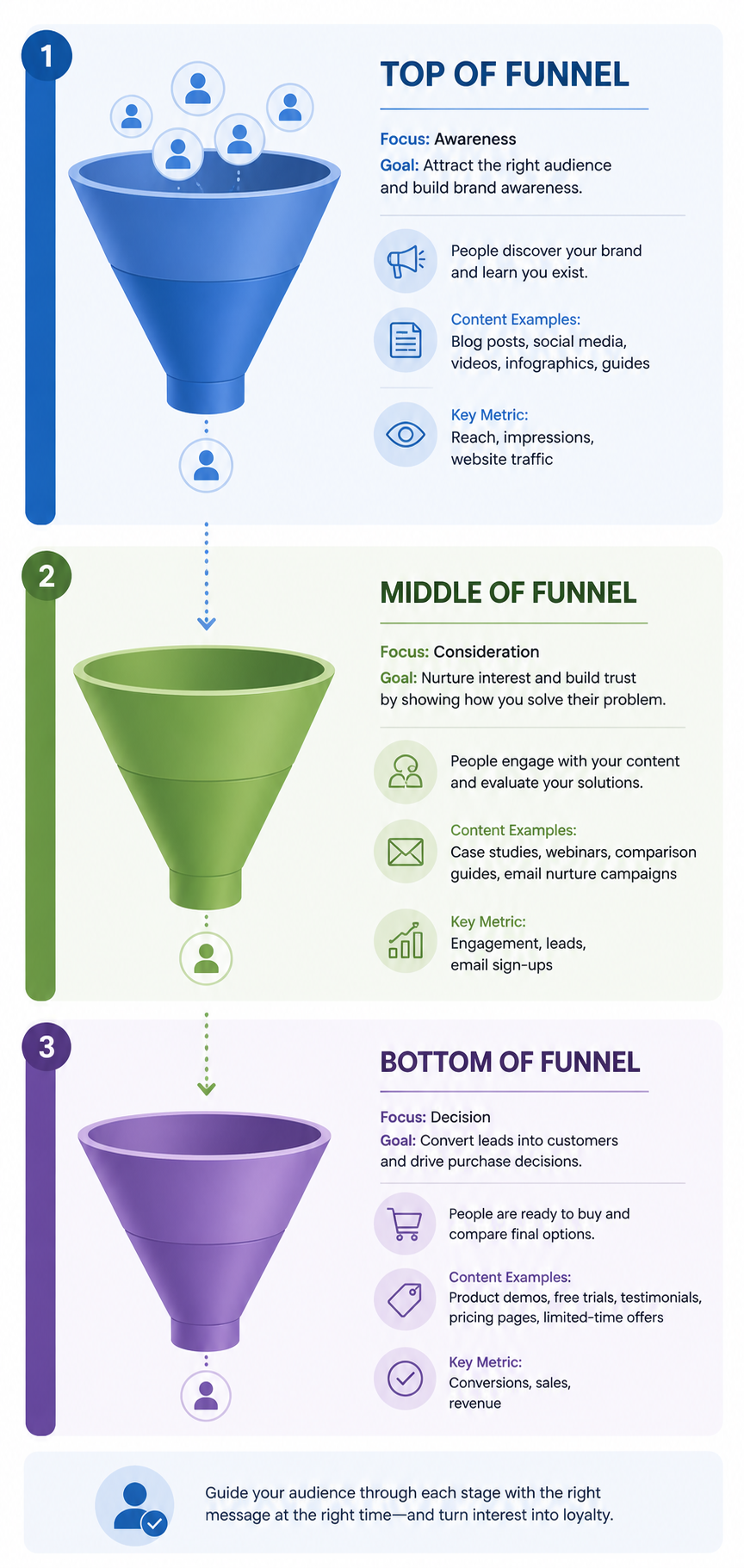
Here's how the funnel breaks down in this scenario:
TOP OF FUNNEL: Awareness
MIDDLE OF FUNNEL: Interest, then Action
BOTTOM OF FUNNEL: Purchase, then Retention

Top of Funnel (TOF) marketing, i.e. AWARENESS
You click to download Schmistine’s amazing free guide, whiz through the content, and put it away to go do the 1000 other things you have to do.
Now let’s put our marketer hat back on.
What’s essential at the AWARENESS phase is having the right content available for someone who is just getting to know you. The consumer has identified a need, problem, or desired outcome… they’re on the hunt for a solution here.
At this stage, your prospect will benefit from things like e-books, tutorials, and case studies as downloads. You’ll also want to touch upon these topics in your wide-reaching channels, like social media, your podcast, or blog.
You’re enticing them to join you down your funnel, where even more goodness awaits. Your welcome email sequence is the mechanism most often used for moving them down to the next stage of the customer journey.
Middle of Funnel (MOF) client, i.e. INTEREST
You're loving Schmistine's vibe and content. You want to do more with her, but not sure what.
Oh, look at that... she just sent you an email with some more awesome, useful content. Obvi you don't unsubscribe because this is some good stuff. You click to read through the article... and OMG there's a cool checklist to go with it. Yes please. You download that too.
Marketer time again...
When your first message to new clients at the TOF phase is delivered with value and clear next steps, it’s your turn to start to show them how they can get to know you better.
At the MOF, prospective clients are probably not yet ready to purchase, but they do feel an affinity toward you. They want to get to know you better – especially because you’re giving them so much good stuff (for free) and you’re offering clarity on how to solve their biggest issues.
You can deepen that relationship by creating interactive experiences and staying top of mind. Tactics here include webinars, masterclasses, and goal-oriented challenges. You stay in front of them with retarget ads, emails, and private social media groups.
Lights, Camera, ACTION
But hold your horses… we’re still in the middle of the funnel here.
ACTION is the next stage we’re going after before we officially say goodbye to MOF.
We’re still in the middle of the funnel when we talk about action as a phase.
As you know from experience as a consumer, it doesn’t necessarily take a purchase to really start to follow a brand.
Some examples of taking action are:
Following and engaging on a brand’s social media page
Watching YouTube videos
Opening and reading emails
Reposting content – maybe even asking them to share the genius gated content piece that got them pulled into this funnel in the first place!
Still with me? Let’s talk about Bottom of Funnel (BOF)
Alright, we’ve made it. The value has stacked up… as a consumer, I can’t believe how much your tips, tricks, and content have already changed my views on what’s possible.
I feel prepared, inspired, and empowered. If only there was something I could PURCHASE...
BOF Part 1: PURCHASE
This stage is a little tricky.
You don’t want to come off as desperate (“hi, we just met, can I kiss you?”) but you do want to make sure that your BOF leads know what you have available. You know, in the event they want to take things further.
Let’s talk about your introductory offer.
Do you have a how-to book you can sell at an entry-level price? A mini-course for beginners? What about a 6-session coaching or consulting package?
All of those are great examples of lower-ticket products and services to circulate across your marketing channels. The key is to promote them consistently and soften their delivery with two parts value and one part call to action.
NOTE: NEVER STOP ADDING VALUE!
Even when someone has made a purchase, you never stop delivering the same informative, nurturing approach they have grown to expect from you.
Think of it this way… at the top and middle of the funnel you have your meet cute and start dating. Bottom of the funnel is where you’re getting married. So unless you want to rack up those therapy bills and move in with your mother, don’t be that crappy husband/wife/partner who stops showing up in your “relationship”.
(Whoa that took a weird, specific turn… and I’m back).
The point is… even though most of these interactions are digitized, you have to remember there’s a real person on the other side of that screen. And their experience once they purchase is as important as before they do.
If you do this right, when you’re ready to launch your next product, or take them into a higher ticket offer, they will remember.
That’s where the final stage of BOF kicks in.
BOF Part 2: RETENTION
Refining and creating follow-up funnels to retain clients once they’ve bought into your brand is one of the best marketing investments you can make.
It costs significantly less to convert once you’ve made a connection with a new client. And not only that, news travels fast so the better their experience, the more likely they’ll become your brand ambassador.
Imagine, with just one click of a share link, you’ve multiplied your pipeline with new partners (and without spending a dime on ads).
Bottom Line
A marketing funnel requires strategy, operational knowledge, copy, and patience.
But it’s something that will pay you back over and over again.
The key to a solid funnel to put yourself in the shoes of the consumer. Understand where they are and what they’re going through every step of the way. You need to make your marketing be about THEM, not about you.
Building out a great sequence of information for new and existing leads requires empathy and creativity.
Ask yourself some questions about the best experiences you’ve had with new products. Can you map out your own journey with them before purchasing?
We’re all just humans trying to make sense of 1000s of options on the web. Put the client’s experience and needs first and your sales will increase.
Ready to build your first marketing funnel (or maximize the return on existing ones)? Click here to book a free consultation and let’s dig in to see what you’ve got.
Frequently Asked Questions About Marketing Funnels
What is a marketing funnel?
A marketing funnel is an automated series of touchpoints designed to move a potential customer from first discovering your brand all the way to making a purchase — and staying a loyal client long after. The term 'funnel' reflects how the audience naturally narrows at each stage: many people become aware of you, fewer engage deeply, and the most qualified convert into buyers. A well-built marketing funnel works for you around the clock, guiding prospects through awareness, interest, action, purchase, and retention — without requiring constant manual effort on your part.
What are the stages of a marketing funnel?
A marketing funnel has three core stages: (1) Top of Funnel (TOF) — Awareness. Prospects discover you through blog posts, social media, podcasts, or ads. Your goal is to offer value and earn their attention. (2) Middle of Funnel (MOF) — Interest & Action. Prospects warm up — they're opening emails, attending webinars, downloading resources. You deepen the relationship with interactive content and consistent value. (3) Bottom of Funnel (BOF) — Purchase & Retention. This is where conversion happens. You present your offer clearly, guide them to a decision, and then keep delivering value to retain them and turn them into brand advocates.
What is the difference between a marketing funnel and a sales funnel?
A sales funnel focuses specifically on the conversion process — the steps from interest to purchase. A marketing funnel is broader: it covers everything that happens before the sale too, including awareness-building, lead nurturing, and trust-building through content, email, ads, and social media. Think of the sales funnel as the bottom portion of the larger marketing funnel. Both are essential — but if you only focus on the sale without building the top and middle, your funnel will run dry.
What is top of funnel marketing?
Top of funnel (TOF) marketing refers to strategies designed to create awareness — reaching people who don't yet know you exist or haven't identified their problem yet. TOF content includes blog posts, podcasts, social media, SEO-optimized articles, YouTube videos, and paid ads. The goal isn't to sell — it's to attract the right audience and earn enough trust that they'll want to learn more. A strong TOF strategy seeds your entire digital marketing funnel with qualified leads who are genuinely interested in what you offer.
How do I create a marketing funnel for my business?
Building an effective marketing funnel starts with understanding your ideal client — their needs, objections, and decision-making process. From there, you create content and assets for each funnel stage: awareness content (blogs, social, SEO), nurture content (email sequences, webinars, lead magnets), and conversion content (sales pages, offers, testimonials). Each stage needs compelling copy, a clear call to action, and a strategy for retaining clients after the sale. If you'd rather hand this off to an expert, I'd love to help — let's talk about what your funnel needs.
What kind of copy does each funnel stage need?
Each stage of the marketing funnel requires a different copywriting approach. Top of funnel copy should be educational, relatable, and value-driven — not salesy. Middle of funnel copy builds trust and deepens engagement through storytelling, case studies, and useful resources. Bottom of funnel copy is where persuasion comes in: clear benefit statements, social proof, objection handling, and a strong call to action. If your business has an in-house writer but the copy isn't converting at every stage, my 1:1 Copy Coaching program is built for exactly this. I work hands-on with your writer using your actual marketing projects — emails, sales pages, ads — giving them direct feedback and strategy training so the improved copy goes straight into your business immediately. No hiring a full-time senior copywriter. No DIY courses your team won't finish. Just stronger copy, faster.
How does a digital marketing funnel work?
A digital marketing funnel works by automating the journey from stranger to customer using online tools: content marketing, SEO, paid ads, email sequences, landing pages, and retargeting. When someone discovers you (TOF), they enter your funnel — typically by downloading a lead magnet or joining your email list. Automated emails and content nurture them through the middle of the funnel until they're ready to buy at the bottom. The power of a digital funnel is that it works 24/7, scaling your ability to attract, nurture, and convert clients without trading more of your time.
How do I write copy for a marketing funnel?
Funnel copy follows the consumer's emotional journey — you're writing a sequence that builds trust over time, not a single piece. TOF content speaks to pain points without pitching. MOF content positions you as the guide and your offer as the solution. BOF copy communicates the transformation you deliver, handles objections head-on, and gives people a clear, low-friction next step. If your in-house writer is producing copy but it's not moving people through the funnel, my 1:1 Copy Coaching program works differently from a typical course: your writer brings real projects — your actual emails, ads, and sales pages — to our sessions. I review them, give direct feedback on strategy and execution, and your writer applies the improvements immediately. Your business gets better messaging right away, and your team gets smarter over time.
How do I know if my marketing funnel is working?
Measure performance at each stage. At the top of funnel, track traffic, impressions, and lead magnet downloads. In the middle, watch email open rates, click-through rates, and webinar attendance. At the bottom, monitor conversion rates, cost per acquisition, and customer lifetime value. If people are dropping off at a specific stage, that's your signal to revisit the copy, offer, or sequence for that phase. A funnel that isn't converting needs iteration — not abandonment. Not sure where your funnel is breaking down? I can help you diagnose it.
Can I build a marketing funnel without a big budget?
Yes — many of the most effective funnels start simple. You need three things: a lead magnet (a free, valuable resource), an email sequence to nurture new subscribers, and a clear offer with a sales page. Free or low-cost tools like Mailchimp and ConvertKit can get you started. The real investment isn't money — it's strategy and copy. A simple funnel with strong messaging will outperform a complicated one with weak copy every time. Want expert help building a lean, high-converting funnel from the ground up? Start your first step with me here.


Comments